Showing posts with label 11th century. Show all posts

Friday, April 21, 2017

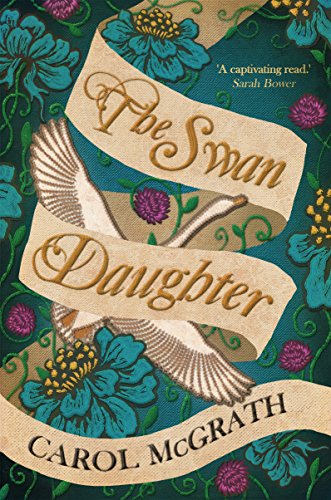
Review: The Swan Daughter (The Daughters of Hastings, #2) by Carol McGrath

It's 1075, Harold Godwinson is long dead, and England is ruled by the Bastard King, William the Conqueror. Harold's family is separated and scattered so they can not conspire a rebellion. His daughter Gunnhild is destined for a nunnery, but she has other plans for herself.

I felt like this book was lacking a lot of things, but despite that it wasn't badly written, and the dialogue was believable. It's the only thing that made me bump it up to 2 stars instead of 1.

One of the things I felt it was lacking was good characterization, I didn't always completely understand the main character's thoughts or emotions. For example, when the main character makes an incredibly bold and rash decision that will massively change her life forever, and doesn't really have any idea whether this will turn out to be a good decision or the worst thing she's ever done, there appears to be no trepidation or second guessing. She blindly accepts what she is told without consideration to the fact that she might be being lied to. She does seem to have some moments of convincing herself this is the right decision, but that's the only inkling we get that she deep down might have an idea that this could go horribly wrong. I could maybe attribute it to youthful naivety, and the thrill of being a woman taking control of her own destiny in 11th century England, but I also felt like I never got a good sense of what she was feeling during it either. We hear her thoughts, but we don't feel her emotions. In the midst of this crazy decision she makes on a whim, the only mention of her feelings are "sublime exhilaration". But was her heart pounding? Was her stomach in knots with both excitement and fear at the same time? Were her hands shaking? Who knows? The author never tells us. She should have been boiling over with some kind of emotions but we barely get any mention of it whatsoever.

The complaint I had about the first book in this series was that I didn't really agree with or understand the main character's decisions. I thought that was primarily because the plot demanded those decisions, and so I thought the second book with a different plot would be different, but I think now my issue with both books is a flaw in the author's characterizations. In this book, I didn't necessarily disagree with the characters decisions, I just didn't understand her thoughts and feelings about those decisions.

The plot was also lacking as well. My other complaint about the first book was that it was anti-climatic and again, I attributed this to the nature of the plot, and hoped the second book would be different but unfortunately, I feel the same way. There's so much that could have been done with Gunnhild's life, for example bringing her face to face with King William, whose army killed her father. But Gunnhild's world was very limited to her home life, which may arguably be an accurate representation of the life of a countess at the time, but it felt like it could have been a story about any noble woman at the time. And not that home life can't be interesting, but other authors have done it better. There was a fabricated event near the end which was an obvious attempt to give it a climax or have something interesting happen with the plot, but it just felt deliberately planted.

On a side note, as a rider myself, I have to point out the scene where Gunnhild is travelling on horseback in her best dress she inherited from her beloved aunt, even though she had the opportunity to change into something more practical. Sorry, but that precious dress would have gotten filthy, even with a outer layer covering it, no one would wear their best clothing to ride a horse if they have another option. I could excuse the first time it happened because they had to rush to escape, but the second time it happened, there was no such excuse. The author made a point of the dress being put safely away while they were on a ship, so the salty sea water wouldn't ruin it, but there is no concern for it with the dirt one gets covered in while riding? This is perhaps nitpicking a bit, and I admit this alone wouldn't be enough for me to dislike a book, as it's not very important, but I still felt the urge to mention it.

Needless to say, I will not be continuing with this series.


Saturday, September 24, 2016

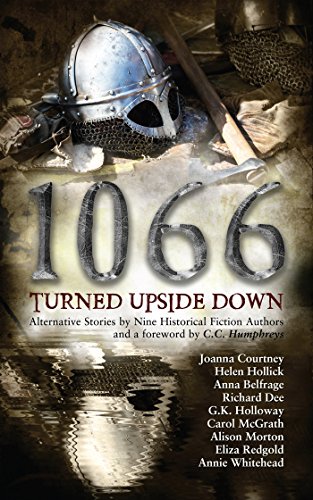
Review: 1066 Turned Upside Down by by Joanna Courtney, Helen Hollick, Annie Whitehead, Anna Belfrage, Alison Morton, Carol McGrath, Eliza Redgold, G.K. Holloway, Richard Dee

It appears that another group of authors has attempted to do what the H Team has done in compiling short stories from each author on a major event in history, except this group is doing it with an alternate history twist. These short stories explore how things would have gone down in 1066 England if Edgar was crowned instead of Harold, or if William of Normandy had lost at Hastings, and several other "what if" speculations.

It also differs from the H Team's books because these are truly individual short stories. Each tale has nothing to do with one another (apart from being based on the events of 1066), which in itself is not necessarily a bad thing. There are plenty of unrelated short story compilations out there which people really enjoy. But it's disappointing when you also consider that most of the stories are so short that you really don't get an idea of how history would have been radically different if these "what if" scenarios had happened. I felt like it posed more questions than it answered. I would have liked each story to not only present an alternate event, but also show us how the succeeding events thereafter would have been different as a result. Don't just show us how the Battle of Hastings would have been different if Harold had won, show us what would have happened after that - how would it have changed England? If they had done that, I wouldn't have minded each story having nothing to do with the next, as it allowed more than one alternate history scenario to be explored.

There were author's notes and discussion suggestions that attempted to explore the resulting events a little bit, which were informative and enlightening, but it just wasn't the same, and wasn't what I was expecting. I did enjoy them though, and actually wound up thinking this might have been a better project had they just approached it with academic essays instead of trying to make them into fictional short stories.

Don't get me wrong, the writing quality from all these stories is very good. But to me, the short stories felt like something that was just quickly thrown together to make each author a few extra bucks on the self published ebook sales, and give them some more exposure. I guess I was hoping for something a little more in depth. However, for only $1.99, it's probably worth the read for those really interested in this topic.


Saturday, June 20, 2015

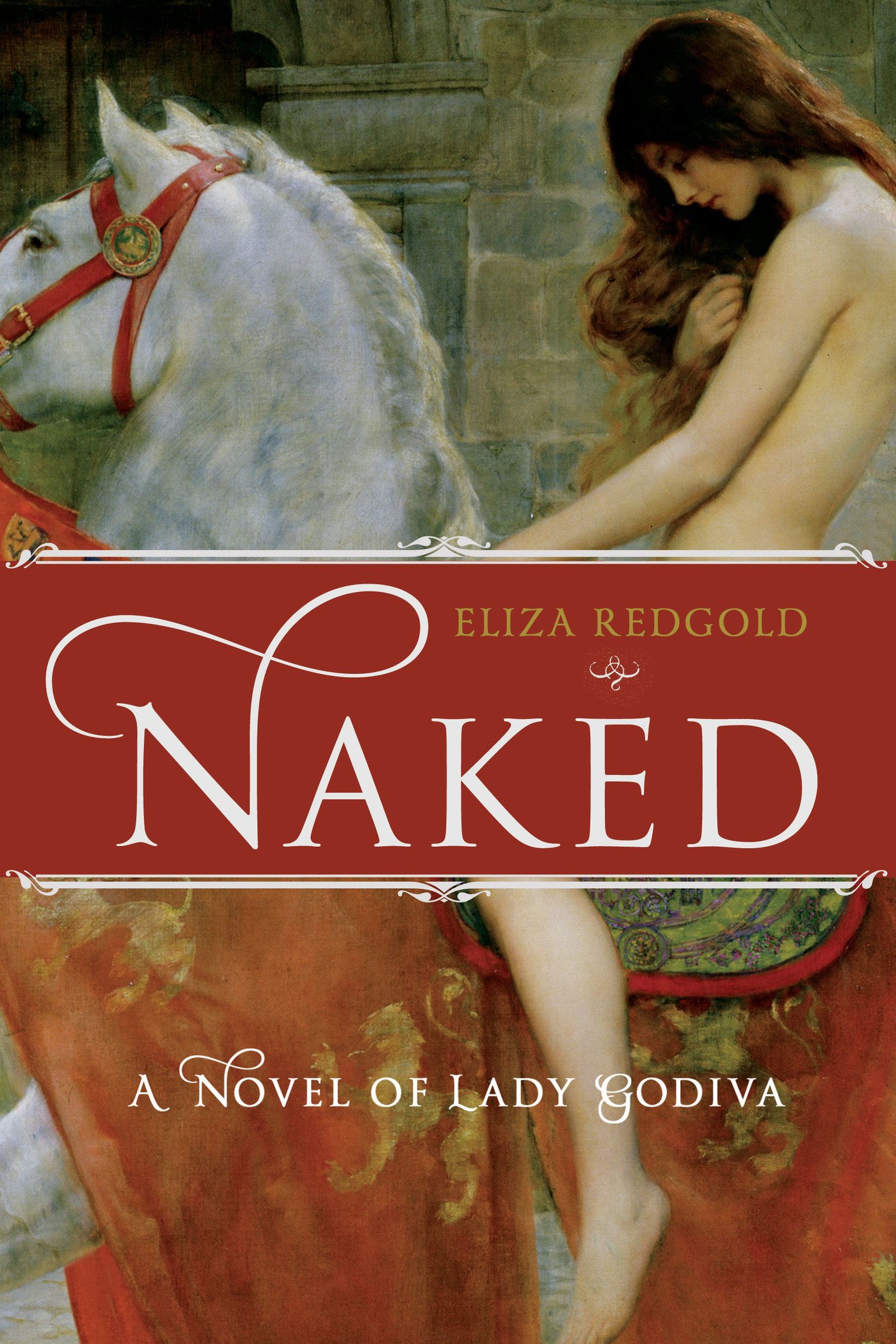
Review: Naked by Eliza Redgold

Advanced review copy from publisher via NetGalley. My opinions are my own.

Release Date: July 14, 2015

This is a retelling of the legend of Lady Godiva, who rode naked through the town of Coventry to convince her husband to lift the harsh taxes he'd imposed on the people there. By proving that she would shame herself in order to save her people from starvation, she succeeded in shaming her husband into lifting the taxes.

Although this is very much a love story, Redgold draws on the political state of England during the 11th century to create a more elaborate tale of deceit and betrayal. It is much more than a simple tale of a selfish and cruel Lord and his high taxes, and his caring wife who makes him see reason. Godiva, a Saxon, lived during England's Danish reign of King Canute. Despite the fact that Canute was viewed as a more apt ruler than his Saxon predecessor, the Danes are very much the antagonists in this story. Leofric, the Earl of Mercia is rebuilding his Saxon lands after they have been decimated by the Danish warrior Thurkill the Tall, while also attempted to prevent the same thing from happening to his neighbors in the Middle Lands, including Godiva's Coventry. Godiva realizes the best way to defend her newly inherited lands from the invading Danes after her parents have been murdered by Thurkill, is to spurn her childhood best friend Edmund, who had hoped to marry her, and instead marry the powerful Earl of Mercia, a man she barely knows. But she fears Earl Leofric only intends to swallow her lands into his own, to gain more power. Can she trust him? Can she rule Coventry as well as her wise parents had?

Godiva is strong, independent, and educated in both politics and battle, having been raised as both son and daughter in the absence of any siblings. At the same time, she is young and can be naive at times, making her a flawed but likable character.

The writing style may take some getting used to for some. Much of it is written with short, choppy sentences which I think was an attempt at sounding dramatic and poetic. However, this may just be a matter of personal preference, some readers may enjoy the writing style. Regardless, it is not unreadable or poorly written, just a different style.

My only complaint therefore is that I feel as though the ending was wrapped up a little too quickly and neatly. The antagonist spills out his master plan and motives in some kind of Scooby-Doo-like reveal, in a clear attempts to explain everything to the reader even though much of it we could have figured out for ourselves. But worse is the fact that Godiva had little to no involvement in or knowledge of any of these greater events going on behind her back, which was a little disappointing. Her world was very limited to Coventry and her marriage (which is spun as a result of her devotion to her lands and people) and yet, despite being told from her first person point of view, the novel still managed to have a steady and eventful plot. In a slightly murder-mystery style, there are clues and mysteries along the way that keep the reader wanting to know more and wanting to read more. All in all, an enjoyable but light read.


Tuesday, February 3, 2015

Review: The Price of Blood by Patricia Bracewell

Buy from Amazon
Advanced review copy from publisher via NetGalley. My opinions are my own.

Release Date: February 5, 2015

This excellent follow up to Shadow on the Crown manages to be fast paced and exciting without sacrificing character development or scene descriptions.

I am hesitant to say that this series is about Emma of Normandy because while it does greatly involve her, it is much more multidimensional than that. Like it's predecessor, it's told from several points of view which include many other developed characters too. It's a novel about a queen who despises her husband but supports him nonetheless for the sake of her son's inheritance; but it's also about a ruthless and distrustful king struggling to hold his nation together as the Danish Vikings raid his lands and his dissatisfied northern lords look for a new ruler. It's about an entirely self-serving woman who would do anything to be queen, and anything to get revenge on those who wronged her. And it's also about an atheling (prince) forced to support a father he has no love or respect for in order to protect his own inheritance which is in direct conflict of the ambitions of the woman he loves. With narratives from all sides and conflicting relationships within each faction, there is nothing black and white about it. With great character development, lots of politics, and a few battle scenes thrown in, it makes this novel very difficult to put down.

Though it is a sequel, it could theoretically be read on it's own because the author does a good job summarizing or recapping what happened in the first book without it bogging down the story. And while I did enjoy the first novel, the second is a great improvement. However, I do think the first book is worth reading to get a better understanding of the characters and their relationships going into the second book.

The Price of Blood covers Emma's life from 1006 to 1012 and knowing Emma's historical life, I know there is still much more to come. I originally heard there was to be two books but Bracewell promises in the Author's Note there will be another, which I am already looking forward to.


Tuesday, April 29, 2014

Book Blast & Giveaway: 1066: What Fates Impose by G. K. Holloway

Please join G.K. Holloway on he tours the blogosphere for 1066: What Fates Impose, from April 14 - May 2.

1066 What Fates Impose1066 What Fates ImposePublication Date: March 4, 2013
Matador Publishing

King William then utters the following words to the room: ‘I appoint no one as my heir to the Crown of England, but leave it to the disposal of the Eternal Creator, whose I am and who orders all things. For I did not attain that high honour by hereditary right, but wrested it from the perjured King Harold in a desperate bloody battle.’

England is in crisis. King Edward has no heir and promises never to produce one. There are no obvious successors available to replace him, but quite a few claimants are eager to take the crown. While power struggles break out between the various factions at court, enemies abroad plot to make England their own. There are raids across the borders with Wales and Scotland.

Harold Godwinson, Earl of Wessex, is seen by many as the one man who can bring stability to the kingdom. He has powerful friends and two women who love him, but he has enemies will stop at nothing to gain power. As 1066 begins, England heads for an uncertain future. It seems even the heavens are against Harold.

Intelligent and courageous, can Harold forge his own destiny – or does he have to bow to what fates impose?

Buy the Book

Amazon UK
Amazon US
Book Depository
iTunes
Troubador Publishing
Waterstones

GK Holloway
About the Author

I have been interested in history since I was a boy, which I suppose explains why, when I came across a degree course in History and Politics at Coventry University that looked tailor made for me, I applied right away. In my first year at Coventry I lived in the halls of residence within a stone’s throw of the Leofric Hotel. In the opposite direction, just a short walk from my halls, is the bell tower that houses a clock, which when its bell chimes the hour, produces a half size model of naked Lady Godiva riding a horse for the titillation of tourists. Above her, Peeping Tom leans out of a window for a better view. In all of the three years I was there, it never once occurred to me that I would one day write a book featuring Earl Leofric and his famous wife, as key players. After graduating I spent a year in Canada before I returned to England to train as a Careers Officer in Bristol. Later, I lived and worked in Gloucestershire as a Careers Officer and then in Adult Education as an Education Guidance worker. After I met my wife, I moved back to Bristol to live and I worked at Bath Spa University as a Student Welfare Officer for a number of years. It was about this time I read a biography about King Harold II which fascinated me so much I read more and more about the man and the times. I found the whole pre-conquest period of England so interesting I couldn’t understand why no one had written a novel about it. So, I decided to write one myself. Now, after many years of study and time spent over a hot keyboard, I have finally produced that novel. 1066: What Fates Impose is the result of all that study and hard work and is the first book I’ve written. I am now working on a sequel.

Virtual Tour and Book Blast Schedule

Monday, April 14
Book Blast at Kincavel Korner
Book Blast at Historical Fiction Connection

Tuesday, April 15
Book Blast at Passages to the Past
Book Blast at Let Them Read Books

Wednesday, April 16
Review at Svetlana's Reviews and Views
Book Blast at To Read or Not to Read

Thursday, April 17
Book Blast at Closed the Cover
Book Blast at Historical Tapestry

Friday, April 18
Book Blast at Time 2 Read
Book Blast at The Bookworm

Monday, April 21
Review at Flashlight Commentary
Book Blast at Griperang's Bookmarks

Tuesday, April 22
Review & Giveaway at Broken Teepee
Interview at Flashlight Commentary

Wednesday, April 23
Review at Oh, for the Hook of a Book
Interview at The Maiden's Court

Thursday, April 24
Interview at Oh, for the Hook of a Book
Book Blast at Reading the Ages

Friday, April 25
Review at Impressions in Ink
Book Blast at Ink Sugar Blog
Book Blast at The Mad Reviewer

Monday, April 28
Review at Kinx's Book Nook
Book Blast at Just One More Chapter

Tuesday, April 29
Review at CelticLady's Reviews
Book Blast at Historical Readings and Reviews

Wednesday, April 30
Review at Historical Tapestry
Book Blast at Book Nerd

Thursday, May 1
Book Blast at Caroline Wilson Writes

Friday, May 2
Review at Curling Up By the Fire
Review at Confessions of an Avid Reader
Book Blast at A Book Geek
Book Blast at Layered Pages

Giveaway

To win a copy of 1066: What Fates Impose please complete the Rafflecopter giveaway form below. Giveaway is open to US residents only.

Giveaway ends at 11:59pm on May 2nd. You must be 18 or older to enter.
Winners will be chosen via Rafflecopter on May 3rd and notified via email.
Winners have 48 hours to claim prize or new winner is chosen.

  a Rafflecopter giveaway  photo 14564486-c3f3-4ae9-a8d4-fec84ea8cc6e.png

Saturday, December 28, 2013

Review: The Handfasted Wife by Carol McGrath

What happened to Harold Godwinson’s first wife Edith Swaneck (or Elditha as she is known in this novel) after his tragic death during the 1066 Norman Conquest? Too often, women are merely a footnote in history and I love historical fiction which speculates about the unknown, untold stories of women in history. Instead of focusing on Elditha’s life leading up to the conquest, this novel explores the after events. How did this woman cope with losing her husband and the father of her children first to another woman and secondly to death and the Norman invasion? What was her fate and the fate of her children once they were in the hands of the enemy and what did she do improve their chances at safety and happiness?

On one hand, this approach certainly set it apart from other books focusing on the Norman Conquest and allowed for more creative freedom but on the other hand, it wound up being a little anti-climatic to focus on the events following 1066 rather than leading up to it. While the book was very eventful, I didn't really get a sense of the emotional turmoil both Elditha and others would have gone through upon learning the outcome of the Battle of Hastings, not on the scale I expected anyway. What should have been the biggest event of the book was quickly passed over in the beginning and while the following events were thrilling at times, without giving away any specific spoilers, they wound up being all for nothing. The efforts Elditha made to escape and keep her children safe were moot in the end and I struggled to understand how Elditha could abandon her children as many times as she did. Granted, she had many children and they were split up and she always left them in trusted care and sometimes she didn't have a choice - but sometimes she did and I just think if I had been her, I would be doing everything I could to remain with my most vulnerable children, whatever the cost to myself. When she finally attempted to extract one of them, she unnecessarily risked everything she'd spent half the novel accomplishing. So that was a little frustrating.

That said, it was very well written and researched. The dialogue and characters were realistic, even if I didn't always agree their decisions. It was written in third person, mostly from Elditha's point of view but also a few others. When it was told from a male point of view, it was still in relation to the women's world, as this is very much a story about women and we do not get to see the Battle of Hastings in action. The author had a lot of room to work with a creative license since soon after Hastings, Elditha disappears from records so her fate was open to lots of speculation and the author used her knowledge of the times to make believable assumptions. This is the first in a planned trilogy called Daughters of Hastings and I look forward to the second two which are to feature Elditha's daughters Gunnhild and "Thea" (renamed such in the novel because her real name, Gytha, would have caused confusion with more than one character named Gytha), I am interested to see what the author does with these characters.


Thursday, April 11, 2013

Review: Shadow on the Crown by Patricia Bracewell

Being the second of only two novels written about Emma of Normandy so far, it’s difficult not to compare this to the first, Helen Hollick’s The Forever Queen. Hollick’s novel is one of my favorites and so it would be difficult to stand up against in my eyes. At the same time, it's difficult to compare them because this novel only covers a portion of Emma's life whereas Hollick's novel covers her whole life.

Shadow on the Crown tells a tale of a strong young woman well groomed for queenship who finds herself a near prisoner of a husband who does not trust her. Her fate is in the hands of her brother, who will most likely put her in jeopardy by breaking his agreement with the English king - an agreement that was sealed with Emma’s marriage. And her attempts to make friends at court are rejected by her eldest wary stepsons and sabotaged by a jealous rival. Her position will be secured and protected if she bears a son but this is also the very thing that threatens her stepson’s positions as heirs. It’s told in third person, from the four points of view of Emma, King Æthelred, his son Æthelstan, and Elgiva (Ælfgifu of Northampton), the daughter of an Ealdorman.

It’s very well written but I don’t think the characters were quite as well done as Hollick’s. The antagonists were pretty one dimensional and I felt like the romance between Emma and Æthelstan was very sudden and unexpected. I don't fully understand what prompted Æthelstan to give Emma a chance and I felt like he did a very quick 180.

I felt like Bracewell took a lot more liberties with the unknown than Hollick did. It worked well for the story but it did make it feel less likely to have really happened. I don't mind authors taking a creative license though, as long as it works and makes sense, which it did, and there is a lot unknown about Emma which the author had to work with.

There's no denying this was a well written and well crafted story that was very enjoyable. Though it’s the first in a trilogy whereas Hollick’s novel on Emma is stand alone (there is a sequel but it does not strongly feature Emma), I’d say being split into shorter novels makes it easier to read and maybe more appealing to the mainstream. I’d still rank Forever Queen higher but I am looking forward to the next in this trilogy from Bracewell.


Related Posts Plugin for WordPress, Blogger...