Showing posts with label france. Show all posts

Tuesday, June 19, 2018

Review: April in Paris, 1921 by Tessa Lunney

Release Date: July 3, 2018

Kiki Button, a former nurse and spy during WWI, is now a gossip columnist in post-war bohemian Paris who just wants to drown the memories of war with parties, booze, jazz, and sex... except her past isn't finished with her.

It sounds a little more exciting than it is. The majority of the first half of the book is primarily about Kiki hob-nobbing with the rich and famous, which is, to say the least, a bit boring. I understand it's setting the stage for the second half, but it's still boring. The author tries to keep things intriguing with sex scenes (though not very explicit) and constantly mentioning the mysterious and dangerous "Fox" character from Kiki's past and his poetically cryptic clues about finding a mole, but it fails to be quite as compelling as it's supposed to be, probably because he comes off more as creepy and stalker-ish than fascinating.

That said, it is well written with witty dialogue, and the characters do have well formed back stories. The second half was much more interesting and finally felt like there was a plot, but by that point I just wasn't hugely invested in it.

Advanced review copy from publisher via NetGalley. My opinions are my own.


Tuesday, August 1, 2017

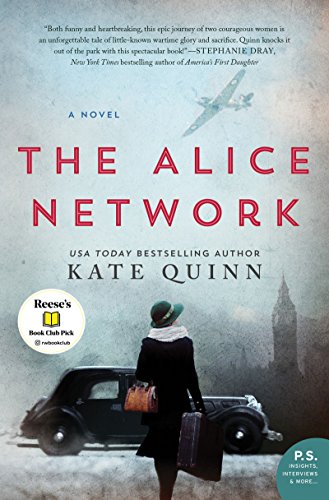
Review: The Alice Network by Kate Quinn

I thought this was a very interesting way to essentially tell the story of Louise de Bettignies, a French female spy for the British during WWI. It covers two time periods, one during WWI, and the other just after WWII. It was strange the way Europe was still recovering from WWII in the later time period, and yet in the "flashback" chapters, we're in the midst of WWI, not in the midst of what created the devastation we see in 1947. I had to remind myself sometimes that two different wars were at play in this story. It put into perspective the fact that the World Wars weren't that far apart, and that the effects of war are inevitably the same.

But it was also about so much more than just Louise de Bettignies. It tells her story, and does her justice, but it also tells the story of many fictional characters, and in spite of being fictional, their stories are very real. It deals heavily with issues of PTSD and the human side of war, but it's also about a young woman finding her way in life, and an older woman coming to terms with her past.

It was wonderfully well written with characters that fully come alive, and a compelling plot that literally made it impossible to put down at times. I can't say enough good things about it - just read it and see for yourself.

I only have one question - is that a morally questionable hat on the cover?


Sunday, September 4, 2016

Review: America's First Daughter by Stephanie Dray and Laura Kamoie

When I first started this novel, I wondered how the life of the daughter of one of our founding fathers, and not the man himself, could possibly fill such a long book (over 600 pages). Sometimes authors like to take a lesser known relation of a historical figure and give them a voice but it just doesn't work out well because their life just isn't as interesting. I figured it would be all about Thomas Jefferson himself and his affair with his slave, Sally Hemmings, and when things like that are told from a third party perspective, it tends to be lacking. But while that was one of the sub plot lines, Martha Jefferson's own story was not lacking and no less fascinating than any novel on Thomas Jefferson himself could be. It's actually amazing how much the authors managed to fit into only 600-some pages.

The beginning was a little bit of a slow start, but the writing was excellent, and the character development is what really makes this book great. I did often wonder why Martha was so dedicated to a father who frankly could be rather selfish sometimes. I understand it had to do with losing her mother, but I couldn't help feeling like at some point enough should just be enough. That's not necessarily criticism though, I appreciated that Martha was a flawed character, it made her human. And not just Martha, but all the characters were so well formed, so complex, so believable, and so sympathetic. Combined with a surprisingly eventful plot, I just couldn't wait to see what would happen next and how the characters would handle it. So much had already happened in just first half of the book, and I knew there was so much more to come, it truly felt like something of an epic saga.


Monday, October 12, 2015

Review: Médicis Daughter: A Novel of Marguerite de Valois by Sophie Perinot

Advanced review copy from publisher via NetGalley. My opinions are my own.

Release Date: December 1, 2015

So many novels focus so much on Catherine de Medici, Queen of France, that it was good to see something paying more attention to her daughter, Margot.

It is well written, even if it is in present tense which isn't my favorite. It's also written from Margot's first person point of view, beginning with her as a child. Over the first half of the book, we see her growing up, which is great for character development, but also means that much of it is about her teenage crush on the Duc de Guise. While it is not a one dimensional romance, it's also not hugely multi-dimensional either. There were many political events going on but we only saw them from Margot's perspective, which was mostly in how it related to the Duc de Guise or Margot's marriage/prospects. I suppose this is to be expected of a teenage princess in the 16th century though but what annoyed me was Margot desire for power and influence such as her mother has, yet she does nothing to gain it because she's so obsessed with Guise and therefore winds up as nothing but a pawn.

None of this is to say it wasn't an enjoyable read though. It's easy to read, the characters are engaging and it was interesting to watch Margot grow and learn. The last quarter of the book in particular was the highlight, as Margot developed a more worldly perspective in the face of the St. Bartholomew's Day Massacre and finally came into her own. I am hoping there will be a sequel because I know Margot's life after the massacre was also very eventful and I think Perinot could tell it well.


Friday, June 20, 2014

Review: The Agincourt Bride by Joanna Hickson

The Agincourt Bride by Joanna Hickson is more of what The Forbidden Queen by Anne O'Brien should have been (read my full review of Forbidden Queen here). Both novels are about Catherine of Valois but Agincourt Bride is a more multidimensional story of politics and court intrigue told from a woman’s point of view with better developed characters, whereas Forbidden Queen is a flat, one-track romance with a whiny, annoying main character. In Agincourt Bride, we get to see many of the characters develop, whereas in Forbidden Queen, we really only see Catherine and her love interests develop and even that is very one dimensional. However, Agincourt Bride is not without its flaws as well.

It tells Catherine’s story from the first person point of view of her nursemaid (and later, Keeper of the Robe), Mette. This winds up being a little limiting in terms of telling the whole story when letters written by Catherine to her brother are inserted in order to give us glimpses into her side of the story. The letters just felt too deliberately planted and are a testament to the drawbacks of writing in first person. Additionally, perhaps because we are seeing all the characters through Mette’s eyes, Catherine is portrayed as saintly while practically everyone else in the story is mean-spirited or even evil. Even some of the protagonists, like Catherine’s brother Charles, are not portrayed in the most favorable light. It seems only Mette and Catherine’s loyal friend from the convent, Agnes, (and later, Mette’s daughter) are goodhearted people who care for Catherine or treat her with any kind of respect. And yet despite this, we don’t really get to know Agnes very well. Despite she and Mette being Catherine’s most trusted friends and supporters and therefore constantly being around one another, they don’t really have any kind of relationship. That’s not to say they dislike each other, just that the only mention Mette makes of what she thinks or feels about Agnes is when she first meets her and decides that anyone devoted to Catherine is alright by her. To the reader, Agnes winds up feeling like a tacked on character who exists purely because the story occasionally needed another character who had Catherine’s best interests at heart.

Regardless, the overall story is still enjoyable and certainly had it’s strengths. In history, Catherine of Valois was a powerless pawn in the complicated politics of the Hundred Years’ War and the Wars of the Roses. Particularly in her time before and during her marriage to Henry, she didn’t really do anything significant except give birth to the next King of England. Therefore, she was always going to be a difficult subject to write about, particularly when it comes to her early life, while still making her story interesting and her character likable, yet Hickson pulls it off. We are shown a woman who faces her fate bravely and wisely, even if she’s had no say in what direction her life will take. Hickson manages to create nearly an entire book out of Catherine’s life before she even married Henry V. While I’m not sure how much of the more intimate details are accurate (I’m certain some liberties were taken), it shows the turmoil that France was in at the time and how Catherine was caught up in it, something Forbidden Queen was seriously lacking. We get to see all of Catherine’s siblings develop and here was where Mette’s point of view was very beneficial, because we got to know Catherine’s siblings as children, when Catherine was too young to really know them, and again later as adults. Catherine’s mother plays a strong side role and we also occasionally see her mentally ill father. Burgundy plays a large role as the antagonist, with much of the politics centering around him. Henry is only really prominent in the last quarter of the novel but he was among the more complex characters.

So the story had its strengths and weaknesses but if you’re looking for a novel about Catherine of Valois, this (and likely its sequel, The Tudor Bride, due out in the U.S. March 2015 and already available in the U.K.) is definitely the better choice than The Forbidden Queen. I will likely read the sequel because I’m curious what the author will make of it. If she can make Catherine’s life before marriage this eventful, I definitely want to see what she can do with the latter portion of Catherine’s life.


Saturday, January 25, 2014

Review: The Forbidden Queen by Anne O'Brien

Advanced review copy from publisher via NetGalley.
US release date: January 28, 2014

This biographical novel about Katherine of Valois, queen consort to Henry V of England and later the wife of Owen Tudor, is well written but doesn't have much depth and there is a lot more "telling" than "showing".

It's primarily a romance and though I enjoy some good romance, when there seems to be little to nothing else going on, it feels flat and grows tiresome and dull. It was entirely about Katherine's romantic relationships, even though there was plenty of opportunity to develop a more multidimensional story, it never took fruit. For example, Katherine's childhood is very quickly brushed over. Growing up, her only friend in the whole world is her sister, Michelle, but when Michelle leaves the convent they are being raised in to be married off, it barely gets a mention. What should have been a huge and difficult change and loss for Katherine only gets commented on after the fact, almost as in afterthought. I also found it very convenient (i.e., unrealistic) that Michelle happened to live close enough by to make regular trips to visit Katherine. Even so, Katherine should have missed Michelle a lot more than we get to see, if not when Michelle is married than certainly when Katherine is married and leaves France for England.

There also could have been a lot more development in showing Katherine adjusting to life at the English court and trying to fit in. While she does make a few friends, we don't see much of them. I would have liked to see more of her dealings with her "damsels", especially in the beginning, because they would have been a huge part of her life, regardless of whether her relationships with them were positive or negative. But we really only see few glimpses of this because the focus was so centered on her romantic relationships. Later, we see a little more involvement but no more than is necessary to move the romantic stories forward.

According to Katherine, in her time as an English queen, she makes it a point to learn about the political affairs going on at the time but we don't really get to see that growth, we just have to take her word for it. As time goes on, she only proves just how poor her understanding of politics is and that she clearly did not learn much during her reign as consort.

Most annoying of all was how whiny, immature, and self-absorbed Katherine was. I could excuse it in the beginning because she was young and starved for attention and love. But she never seemed to grow up. While her time with Henry was short lived, I grew frustrated when she could never accept the fact that when you're married to a king, certain things will take priority over you. She could not see beyond her own little world. Her happiness seemed entirely dependent on attention from men, which made her seem shallow and vapid, in addition to immature and self-absorbed. At one point, Katherine even asks herself: "Was every woman as driven to embrace misery as I, when faced with a man who had no desire for her?" The answer, of course, is "no". No, Katherine, not every woman feels that way and the fact that you do is actually rather pathetic. I won't pretend rejection is a barrel of laughs but the degree of misery that it sunk her into was certainly pathetic.

Also annoying was when, by her own admission, she knew nothing about Owen Tudor beyond the fact that he was good at his job, and yet claimed to have fallen in love with him. How can you love someone you don't even know? Even after she professed to have grown up and been wiser, she is still resorting to an immature ideal of love.

The quality of writing is not bad and the characters, though mostly unlikable or underdeveloped, were believable, as was their dialogue. But the story was one-dimensional and Katherine in particular was not a likable main character, which was made all the more annoying by the fact that it was told from her first person point of view.


Saturday, October 19, 2013

CW's Reign

Ad for 'Reign' showing the fictional
'Bash' character and inaccurately
portrayed Dauphin Francis.
I intended this to be a book review blog but after just watching the CW's pilot on Mary, Queen of Scots, I had a few things to say about it. It does contain a few spoilers, I've written it on the assumption of those reading this have already watched the first episode.

The show opens with a teenage Mary living in a convent in France and, after an assassination attempt, is sent to live at the French court, where she briefly had spent some time before when she'd first arrived in France as a child. This of course is inaccurate, the real Mary never lived in a convent, she grew up at the French court after arriving there at five years old. I could excuse this though, it made some sense to introduce the audience to the story at the same time that Mary was being reintroduced to the French court. It means that we learn things about the court as Mary learns them, which helps us empathize with her. Although she knows many of the people at court, she is learning about them as an adult and therefore, in a way, she is new to the court and still settling in. It's a good starting point, even if not true.

When Mary arrives at the French court, we discover that she is betrothed to the Dauphin of France, the heir to the throne, Francis. Understandably for a teen show, it centers on romantic intrigue when Francis is already involved with a random pretty girl at court, complicating his feelings for Mary, while Mary herself finds some emotional refuge with Francis' half brother, the king's bastard 'Bash' (short for Sebastian). Meanwhile, the romantic interest of one of Mary's ladies fills a sub-plot while another of her ladies gets involved with the king himself when he encounters her masturbating after covertly watching a princess of France lose her virginity on her wedding night. While it's true that the consummation of royal marriages often required witnesses, the idea that the maiden Queen of Scotland and her ladies could sneak a peek from behind a screen is pretty far-fetched. Even more far-fetched is the idea that one of them would masturbate in the middle of a stairwell. The scene was heavily edited down and is really only suggestive, you're left not entirely confident that's what she was doing because apparently, the show's producers felt that showing a young woman discovering and exploring her sexuality on her own is more controversial than a teenage girl having an affair with an grown, married man.

The real Francis and Mary
The other two major inaccuracies I spotted were the introduction of a fictional character, Bash, and the portrayal of Francis. I don't mind storytelling involving fictional characters, even some of the best historical fiction authors make use of them, such as Sharon Kay Penman and Bernard Cornwell. It allows the storyteller greater creative freedom and often creates additional sub-plots, giving the story a more complex and multi-dimensional feel. The danger zone of fictional characters in a historical story is when they get too involved with the main historical characters. If taken too far, it becomes unbelievable that a historical figure had quite so much involvement with someone who never existed, unless there is a good reason they never appeared in the history books despite being a pivotal player. We'll see if 'Reign' goes down that path or not but for now, I can understand why they've created a fictional bastard of the king and his mistress, Diane de Poitiers (historically, Diane had no children by the king, only two daughters who could not have been the king's since they were born around the same time he was). Not only does it involve Diane more in the family politics but Bash also serves as an alternate love interest for Mary, which I guess is practically a necessity when your target audience is teenage girls. In reality, though there's no speculation that Mary was ever involved with a king's bastard, for the sake of a good story, Mary would have been in a prime position to find love elsewhere than with her fiance, not because he was already sleeping with other women, or because he felt it politically unwise to marry her, as the show would have you believe. No, in reality the reason would have been much simpler, though admittedly also much less sexy, because the historical Francis was an underdeveloped, sickly little boy. Already a year younger than the developing and tall Mary, Francis' growth was stunted by his health problems and made the age difference between them seem even greater. Though by all accounts, Mary got along with and cared for Francis, it was probably more as a little brother than as a passionate lover. So it's not unreasonable that a fictional story would speculate on Mary finding love elsewhere, I just don't fully understand the need to make Francis a healthy, handsome, strapping young man when he was anything but. Apparently, everyone in this TV show must be attractive and I find it difficult to believe that today's young women are quite so vain that they couldn't appreciate a well portrayed, if unattractive, character. A beautiful young queen and a handsome forbidden bastard evidently isn't enough, pretty much the entire court must be good looking. Even Diane, who as a mistress of the king you might except to be beautiful, is played by an actress in her 30s when in reality she was 20 years the king's senior and approaching 60 by this point.

Scene showing some of the more inaccurate dresses
Appealing to modern young women brings me to my next complaint, the costumes. Apparently, the CW believe that today's teenagers won't be interested in anything even remotely resembling historically accurate costumes. Strapless dresses? Really? Need I say more?

Another romanticized element of this is how much time Mary conveniently gets to spend alone, which of course allows her to have private conversations with Francis and Bash. For the very reason that, in the show, Mary's reputation was nearly ruined when a young man is found in her bed, she equally would not be able to spend so much time wandering around on her own, running into handsome and dashing young men who, of course, fall hopelessly in love with her. In this way, it is more like a fairy tale than history.

While the show might appeal to many for purely entertainment purposes, it's unsurprisingly an epic fail on historical integrity. Still, I can still the appeal as a guilty-pleasure and I support any mainstream entertainment that encourages people, especially young people, to develop an interest in history. If this show gets young women wanting to learn more or picking up books, even novels, about Mary Stuart or French royalty, I hope it runs for a very long time. Perhaps, in that way, it will do for young people what The Tudors did for so many adults, a show that I admittedly loved and that partially sparked my own interest in royal history, despite it's own numerous inaccuracies. Sometimes, a story doesn't have to be historically accurate to be enjoyable and let's hope 'Reign' proves this to be true. I, for one, will continue to watch it if only to see Torrance Coombs' alarmingly beautiful blue eyes again. I never said I was above a bit of eye candy...

Sunday, August 25, 2013

Review: The Passing Bells (Greville Family #1) by Philip Rock

This is the original Downton Abbey. In fact, I’d be very surprised if the creator of Downton, Julian Fellows, hasn’t read this and taken some inspiration from it. The time period and setting, particularly in the first third before the war begins, is precisely like Downton and there are notable parallels among some of the large cast of characters, both upstairs and down.

Much like the Earl of Grantham, Anthony Greville, Earl of Stanmore, is expectedly traditional and struggled to adapt to the changing ways of the world. We soon learn his wife, just like Cora Crawley, is a wealthy American, and that their marriage was a love match. Unlike Robert Crawley though, Anthony doesn’t have to worry about who will inherit his title and home since he has more than one son and a spirited daughter.

Downstairs, we learn that the stiff valet, who could be Mr. Carson’s twin, doesn’t approve of the young, new chauffeur who is perhaps a mix of Downton’s two Toms (Thomas Barrow and Tom Branson). In fact, most of the staff bristle at the chauffeur’s boastful nature, except the new, wide-eyed and bushy-tailed maid who is much like Daisy.

What sets it apart from Downton is that the Greville’s story deals much more with War World I, taking us to the trenches and hospitals on the war front. Downton is strictly about the ongoings at Downton, Passing Bells is more of a WWI novel. It’s really about how the war effects and changes the lives of the many people connected by this great house. Additionally, one thing Abington Pryory is missing is their own Violet Crawley and therefore much of the humor she brings to the TV show is also absent. On the other hand, Passing Bells has a valuable addition in the form of an American cousin who spends time on the front lines as a journalist, giving us an American perspective of the war too.

Still, it will certainly appeal to Downton fans and I highly recommend it to anyone suffering from Downton withdraw during the off season.


Tuesday, August 13, 2013

Review: The Iron King (The Accursed Kings #1) by Maurice Druon

A novel of Philip the Fair of France and the scandalous and violence of his court, first book in The Accursed Kings series about the Capets.

“If you like A Song of Ice and Fire, you will love The Accursed Kings” - George R.R. Martin.

You can imagine my excitement. A Foreward written by one of my favorite authors explaining how this series was one of his inspirations for possibly my favorite series ever.

I don’t know if it’s because this is a translation or if it’s because it was written nearly 60 years ago, or perhaps both, but I found the writing style and dialogue very stiff. The narrative even reads more like a history book at times - very matter-of-fact. I think this was an even bigger let down because of the hype around it, not only revered by readers but recommended by George R.R. Martin. Most of the criticism seems to be from GRRM fans who, like me, picked it up on the back of his recommendation, but it’s important to note that it’s the plot content, not the writing style, which is “Game of Thrones-like”. Don’t expect this to have Martin’s narrative. However, I also read a lot of historical fiction about royalty so this should have been right up my alley even if Martin had never spoken a word about it so it’s not just the comparison to ASOIAF which is causing this to be a disappointment.

I did see some of the influence it may have had on Martin's series though, mostly in the characters, so that is saying something. Isabella reminded me a little of Cersei sometimes, though not nearly as evil. But if I had to recommend something similar to ASOIAF, I'd probably go with any of Bernard Cornwell's medieval based novels/series. Though his cast of characters is not as extensive, his portrayal of the medieval world is very similar, as is his sense of humor. Apparently the two authors are good friends as well.

There is a great story here, if you’re willing to get passed the methodical style of the narrative and dialogue. Those who are used to Jean Plaidy’s writing style, for example, might get on board with this easily (evidence that it has something to do with being written in the 1950s) - and I have been able to enjoy Plaidy’s work so I feel a little hypocritical given this a lower rating. But after my anticipation was so high, this was a greater let down.

I would have liked to see what a more modern translator could do with this, since I’m pretty sure it’s just been reissued as it was at the time of the last release and not re-translated.


Thursday, July 18, 2013

Review: The Bones of Paris (Harris Stuyvesant #2) by Laurie R. King

ARC received from publisher via NetGalley.

Private detective and former FBI agent Harris Stuyvesant explores the darkest sides of the Surrealist movement in Paris as he searches for a woman he briefly met before she disappeared.

There is no denying that Laurie King is an excellent author or that this book is superbly written. However, I found the dark subject matter very disturbing, to the point where I was feeling depressed just by picking my Kindle up, knowing what was waiting for me. I like murder mysteries and I don’t mind if they are dark and violent as it can add realism (ironic, in a book about Surrealism) but this is particularly heavy and gritty. In a way, the fact that the book evoked such emotion in me is a testament to how well written it is but it just got a bit too much for me.

It was also a little too modern for my tastes, although I did appreciate the appearances of certain celebrities from this time period (Man Ray, Cole Porter, etc), I guess I prefer my historical novels to be set pre-WWI.

Lastly, I have to admit I did not realize that this was part of a series and not the first book. I hate reading series out of order and had I known that this book was a sequel, I honestly wouldn’t have requested an ARC. There is definitely a lot that made me feel out of the loop so I would not recommend it to someone who has not read the first book.


Related Posts Plugin for WordPress, Blogger...