Showing posts with label mythology & folklore. Show all posts

Wednesday, June 17, 2020

Review: The Forgotten Kingdom (The Lost Queen Book 2) by Signe Pike

Release Date: September 15, 2020 

The sequel to this series loosely based on Merlin from the Arthurian Legend continues with a broader view told from more than one character's point of view. If I recall correctly, the first book (The Lost Queen) is only told from Languoreth's view point, but now we get to see her brother Lailoken's and her daughter Angharad's thoughts too.  It was a wise improvement, as we got to see more of what was going on beyond Languoreth's world. Interestingly, Languoreth and Lailoken's chapters are told in first person while Angharad's are in third person, perhaps because she is a child.

The series takes an unusual path because my understanding of the Arthurian Legend has always been the Celts battling the Saxons/Angles, but the primary antagonists for most of the book are Christian Britons. The Angles only pose a threat towards the end. It did make me wonder a little bit "where is this going?" But when I say it's loosely based on the Arthurian Legend, I mean loosely - I mean you should throw out everything you know about King Arthur and Merlin before reading it. That's not a criticism, because this is an excellent and arguably more historical reboot, and if you're looking for a totally different take on the Arthurian Legend, this is it.

Advanced review copy from publisher via Edelweiss. My opinions are my own.


Monday, October 1, 2018

Review: The Lost Queen by Signe Pike

Release Date: September 4, 2018 (yes, I'm behind on my advanced review copies)

Although based on the twin sister of the legend who inspired Merlin, I would not say this is the Arthurian legend. "Pendragon" is featured, but he's not among the main characters. It's really about the daughter of a Celtic chieftain, Languoreth (aka Gwendydd in Welsh folklore), after the withdrawal of the Romans, during the invasions of the Angles and Christianity. This has always been a time period that fascinated me because there's so little reliable written history from it. This novel is a mixture of that history and the folklore that predates Geoffrey of Monmouth's Arthurian legend, and really brings this obscure time period to life.

The Celtic mysticism was a little heavy for me, but it was very well written with fleshed out characters, and the plot moved along at a steady pace.

Languoreth character was a little frustrating though. The book goes on and on about how important it was that she marry the high king's son so she (and therefore her father and brother) would have influence at court. But I really didn't see any examples of how she used her influence and power to aid her family, or her people. On the contrary, she usually does precisely the opposite of what her father, advisers, or any other allies tell her to do, and usually with unsuccessful results. She is otherwise a likable character, and the author does well to evoke empathy for her, but I kept waiting for her to do something politically significant since that's what the book had been building up to the whole time.

Additionally, there was one thing that didn't make sense to me but this one might be a bit of a spoiler:


So there were definitely things that let this book down a little bit, but overall it was a good story with excellent prose - the author certainly knows how to bring a scene and setting alive. It begs for a sequel, hopefully one in which the main character is a little more useful.

Advanced review copy from publisher via NetGalley. My opinions are my own.


Wednesday, April 8, 2015

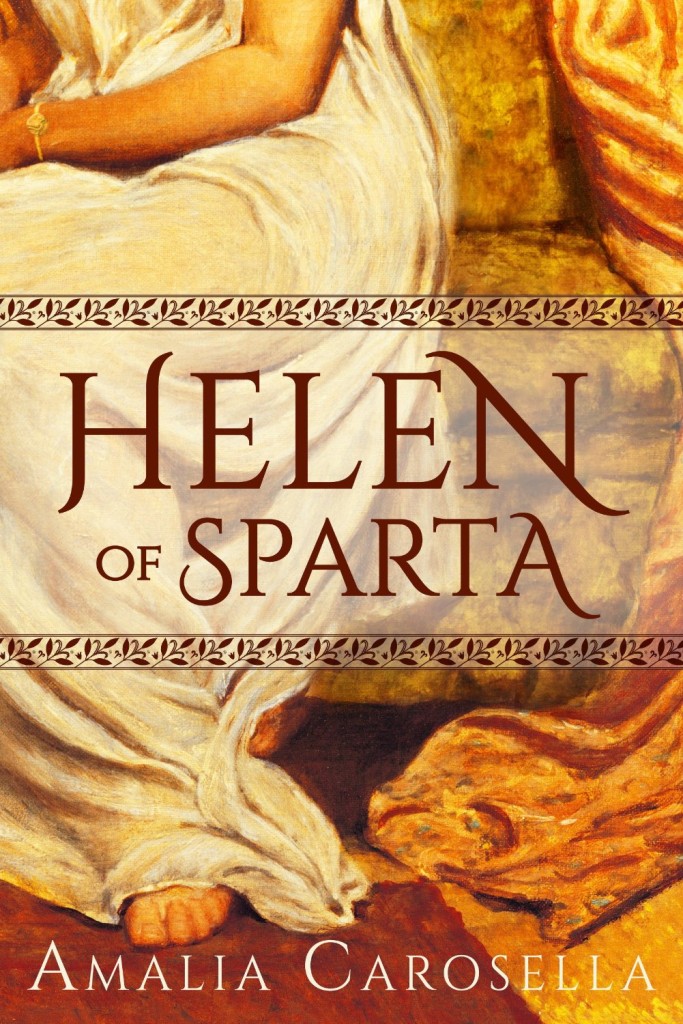
Review: HFVBT Presents Amalia Carosella’s Helen of Sparta Blog Tour, April 1-22

Please join author Amalia Carosella as she tours the blogosphere with HF Virtual Book Tours for Helen of Sparta, from April 1-22.

Publication Date: April 1, 2015
Lake Union Publishing
Formats: eBook, Paperback
ISBN-10: 1477821384

Genre: Historical Fiction

Add to GR Button

Long before she ran away with Paris to Troy, Helen of Sparta was haunted by nightmares of a burning city under siege. These dreams foretold impending war—a war that only Helen has the power to avert. To do so, she must defy her family and betray her betrothed by fleeing the palace in the dead of night. In need of protection, she finds shelter and comfort in the arms of Theseus, son of Poseidon. With Theseus at her side, she believes she can escape her destiny. But at every turn, new dangers—violence, betrayal, extortion, threat of war—thwart Helen’s plans and bar her path. Still, she refuses to bend to the will of the gods.

A new take on an ancient myth, Helen of Sparta is the story of one woman determined to decide her own fate.

My Review

In Greek mythology, before the infamous Trojan War, Helen of Sparta was abducted by Theseus, King of Athens. Based in legend, this novel approaches Helen's 'abduction' with a new take on it, with Helen as a willing participant.

First, I think it should be noted that in my opinion, this is more like historical fantasy than straight up historical fiction. While it's not being marketed that way, there's several usages of magical or mystical powers, and actual Greek gods and goddesses play large roles in the storyline. Not as the characters' belief system, but as the gods and goddesses making actual appearances and interacting with the mortal characters. While that in itself didn't bother me, I felt as though there was too much being explained away by these influences, rather than by providing the characters with good reasons for their choices..

I really wanted to like this tale of the face that launched a thousand ships, because it focused on a less infamous period of Helen's life and I thought it would allow for more character development and let us get to know Helen and other characters and what would motivate their later choices. While it is well written with good descriptions, unfortunately, the characters are rather flat and there were too many times when I felt like their behavior or decisions just didn't make any sense. For example, Helen is worried that Menelaus will rape her and then she'll be forced to marry him - this part didn't bother me since it's true in history that a violated woman would be forced to marry her rapist to save her "honor". What troubled me was that if Helen was so desperate to escape marrying Menelaus, and so prepared to run away with Theseus, why not just claim Theseus raped her (or better yet, sleep with him and then claim it was rape) so then they would be "forced" to marry? As escape plans go, wouldn't this be a lot easier than an elaborate plan to slip away in the night, hid her on his ship, and then come up with a fake identity once in Athens? I understand the whole premise of the story is a twist on Helen's abduction so she needed some reason to run away with Theseus, but if you can't explain why the characters didn't chose a different, more logical, seemingly easier route, the whole concept falls apart.

I also struggled to understand why a princess was so often alone, or wandering the palace unescorted especially when it was full of suitors lusting after her. More than once she is told off for it yet she keeps doing it, even after experiencing unwanted attention when caught out on her own. The one time she does attempt to avoid crossing the palace alone at night, instead of just finding someone to escort her back to her quarters, she stays with her guests until so late at night she is literally nodding off. She has maids and servants, and there's no reason she wouldn't have one with her to see her back to her room.

I could go on with more, greater examples of such illogical behavior but I don't wish to add spoilers. Suffice to say, there was too much in this that didn't make sense or felt contrived for the sake of the plot or scene.

On top of that, I did not find the characters inspiring. Theseus has little depth and serves only as protector, while Helen defines the role of damsel in distress. Though it took guts to abandon and leave behind her whole world, she spends half the time in fearful frets and collapsing into Theseus's arms.

The biggest criticism I'm seeing from other reviews is that the ending is something of a cliffhanger, that it ends too suddenly without closure. I did not feel this to be the case because if you are familiar with the legend of the Trojan War and Helen's story, you know what comes next. The ending was supposed to show the reader why Helen later makes the fateful choice she does, igniting the Trojan War, which it does do. Perhaps it wasn't wise for the author to write a novel that, in the end, only suited people who are already familiar with Helen's story, but that doesn't mean I would say the ending is poor.

So there's definitely some good elements to the story since I was compelled to see the story through to the end, and it's well written, but unfortunately the characters let it down.


Buy the Book

Amazon Barnes & Noble

03_Amalia Carosella Author About the Author

Amalia Carosella graduated from the University of North Dakota with a bachelors degree in Classical Studies and English. An avid reader and former bookseller, she writes about old heroes and older gods. She lives with her husband in upstate New York and dreams of the day she will own goats (and maybe even a horse, too). For more information, visit her blog at www.amaliacarosella.com. She also writes fantasy and paranormal romance as Amalia Dillin. You can also connect with Amalia on Facebook, Goodreads, and Twitter here and here.

Helen of Sparta Blog Tour Schedule

Wednesday, April 1
Review at Unshelfish
Review at Let Them Read Books

Thursday, April 2
Review at Flashlight Commentary

Friday, April 3
Interview at Flashlight Commentary

Saturday, April 4
Review at History From a Woman's Perspective

Monday, April 6
Review at Curling Up By the Fire
Spotlight at A Literary Vacation

Tuesday, April 7
Spotlight at leeanna.com

Wednesday, April 8
Review at Historical Readings and Reviews

Thursday, April 9
Review at Oh, For the Hook of a Book!

Friday, April 10
Review at With Her Nose Stuck in a Book

Monday, April 13
Interview at Book Babe
Spotlight at Historical Fiction Obsession

Tuesday, April 14
Review at Forever Ashley

Wednesday, April 15
Review at Just One More Chapter
Spotlight at CelticLady's Reviews

Thursday, April 16
Review at 100 Pages a Day

Friday, April 17
Review at Impressions in Ink

Saturday, April 18
Spotlight at Passages to the Past

Monday, April 20
Review at Book Lovers Paradise
Interview at The Maiden's Court

Tuesday, April 21
Review at Broken Teepee

Wednesday, April 22
Review at Ageless Pages Reviews

 photo 3f369836-d23e-4009-8e3c-831cc71b66d6.png

Monday, March 3, 2014

Review: Pendragon's Banner (Pendragon's Banner #2) by Helen Hollick

Hollick’s Pendragon series set out to tell a more realistic story of the Arthurian Legend and she certainly accomplished that. The downside to reading King Arthur books is that most of time, you already know what’s coming but with this series, you’re never quite sure. Hollick took full advantage of letting loose her creativity.

At the same time, there are many of the more classic elements that we all know of the legend, just not always exactly how we know them. The thing about folklore is, of course, that it’s told orally for generations, even centuries, before it’s written down so in theory, if Arthur were a real historical figure or based on one, you would actually have to assume that the legend we know today was warped and evolved over time. Hollick seems to have set out writing with this in mind, building a story where nearly all the classic elements are there but many of them are not exactly how we know them, crafting a believable idea of how this element was warped into that or that character got confused with this.

And yet the story doesn’t feel contrived or reverse engineered. The characters are fleshed out and the story is unpredictable. I can’t wait to read the final book and see where Hollick takes it next.


Wednesday, February 12, 2014

Review: A Brief History of King Arthur by Mike Ashley

This is called A Brief History because it's basically half of the larger volume "The Mammoth Book of King Arthur" by the same author. It essentially analyzes the historical basis for King Arthur whereas "Mammoth" also explores possible identities of other major characters from the Arthurian legend as well. It is only "brief" in comparison to "Mammoth" because trust me, there is nothing truly brief about this. It is a very detailed, very in depth look at the time period in which Arthur must have existed (if he did) and all the possible individuals who may have been the inspiration for Arthur, which may have been one or a combination of historical leaders.

It essentially defines Arthur as the victor of the Battle of Badon and then goes about narrowing down the likely date for Badon and analyzing which historical figures lived during this time period and might have contributed to the legend of Arthur.

It's very interesting and worth reading but the nature of the subject matter makes it not very easy to follow if you're not already familiar with the historical sources, events, and figures from this time period. Don’t take this on lightly but do take it on if you're interested in the historical basis for the legend of King Arthur.


Tuesday, November 19, 2013

Review: The Lost Sisterhood by Anne Fortier

Received ARC from publisher via NetGalley.
Release date: March 11, 2014

Philologist Diana Morgan has always had a fascination with the legend of the Amazons from the time her supposedly mentally ill grandmother claimed to be one and even gave her a notebook with a dictionary of a strange, unknown language. So when Diana is approached by a mysterious man with a photograph of an archaeological site covered in the very same language (which I suspect is supposed to be the language from the Phaistos Disc), she can’t resist the offer to investigate.

Running parallel to her story is that of Myrina, a young woman struggling to survive within classic tales from Greek mythology and Homer's Troy, who will stop at nothing to protect her younger sister. But Fortier's retelling is anything but traditional and manages to put realistic spins on The Iliad that link several elements from history and mythology. Though the premise of novels like this can sometimes be a little far-fetched, this was one of the more believable ones.

I love a good treasure hunt/archaeological mystery and the fact that it was based on Greek mythology intrigued me more. From the time I was 12, when I first learned about classical mythology, I've been fascinated by it so this was right up my alley. There's lots of action and adventure as Diana follows clues taking her in Myrina's footsteps across the Mediterranean but the character development isn't neglected either and the personal journeys that both the main characters go through make it difficult to put down. 608 pages may be longish for an action novel but they flew by. The feminism could be a little heavy handed at times but that's to be expected from a novel about a sisterhood and it's important to remember the brutal world the Amazons lived in and particularly how women were often treated.

While Diana's chapters are told in first person, Myrina's are told in third person, which is not normally something I'm fond of but it works well to distinguish the different time periods. Despite being split over thousands of years, the book flows between the two worlds effortlessly.


Related Posts Plugin for WordPress, Blogger...